How to Launch 32 Facebook Ads That Actually Get Results (Not Just 1 Ad That Flops)
By Keven Bermeo · · 22 min read
Most pressure washers launch one ad with a before/after image, spend $130 at $60-70 cost per lead, get zero jobs, and quit. Their business is gone within 18 months because they never figured out Facebook ads.
I'm going to show you exactly how to avoid that. This is the 32-ad system I use to scale pressure washing businesses. It's the same system that's generating $8-10 cost per lead results right now.
The Fatal Mistake (Why Most Pressure Washers Fail)
The Typical Scenario
- Launch ads at $10/day
- Use basic before/after image
- Get zero leads or $60-70 cost per lead
- Spend $130 total
- Get no jobs closed
- Give up and say "Facebook ads don't work"
- Business fails within 18 months
The Core Problem
"You cannot scale Facebook ads with only one ad prepared. That's not how this works."
Most people quit because they launch a before/after image, it flops, and they have nothing else to test. You're competing against people like me who launch 32 ads systematically, and we're taking all your potential leads.
Prerequisites: What You Should Already Know
Before Using This System
You should already understand:
- How to access Facebook Ads Manager (adsmanager.facebook.com)
- Creating a Leads Objective campaign
- What campaigns, ad sets, and ads are
- Basic targeting and placement settings
- How to write primary text
If you don't know these basics, watch beginner Facebook ads tutorials first. This guide covers strategy and system architecture, not basic platform navigation.
The 32-Ad System Overview
What You're Building
- 4 campaigns (each with different offers)
- 8 ad sets total (2 per campaign)
- 32 ads total (8 per campaign, 4 per ad set)
- Staggered launch schedule (3-day intervals)
- Total time investment: 2-3 hours to build everything
The Investment Question
"Would you invest 2-3 hours to make an extra $4,000-6,000/month just from Facebook ads?"
Your competition isn't doing this. I know that because I'm competing with them when I launch ads in their cities. This is what keeps you ahead.
Campaign #1: Complete Structure Breakdown
Campaign Setup
- Objective: Leads
- Type: Manual leads campaign
- Optimization: Optimize for leads (NOT engagement)
- Campaign name: Name it after your offer (e.g., "$199 House Wash")
Ad Set Configuration (2 Ad Sets Per Campaign)
Targeting Settings
- Location: 10-mile radius around your city
- Age: 30-65 (homeowner demographic)
- Gender: All
- Interests: NONE (unless you're in Houston, Miami, LA, or NYC)
Placements (Critical)
- Switch to Manual Placements
- Select Feeds only
- Turn OFF: Marketplace, Search, Stories, Reels
- Do NOT use Advantage+ Placements
Budget
- Ad Set 1: $5/day
- Ad Set 2: $5/day
- Total campaign budget: $10/day
Ad Structure (4 Ads Per Ad Set)
Here's how the 8 ads break down across 2 ad sets:
Ad Set 1 (4 ads):
- Ad 1: Copy 1 + Creative 1
- Ad 2: Copy 1 + Creative 2
- Ad 3: Copy 2 + Creative 1
- Ad 4: Copy 2 + Creative 2
Ad Set 2 (4 ads):
- Ad 5: Copy 1 + Creative 1
- Ad 6: Copy 1 + Creative 2
- Ad 7: Copy 2 + Creative 1
- Ad 8: Copy 2 + Creative 2
What This Tests
- 2 different ad copies (same offer, different wording)
- 2 different creatives (images or videos)
- 4 variations per ad set to identify winners
Creating High-Converting Ad Copy with ChatGPT
The 5-Part Ad Copy Structure
Every high-converting Facebook ad follows this exact structure:
Part 1: The Hook (First 2 Lines)
Purpose: Grab attention before they scroll
Why it matters: Users only see the first 2 lines before "See More" appears. If your hook doesn't stop them, they scroll past.
Part 2: The Meat & Potatoes (Storytelling or Benefits)
Two approaches:
Storytelling Format:
- Share a customer story
- Describe a common problem you solved
- Create relatability and emotion
- Written in paragraph format
Benefits Format:
- Use green checkmarks ✅
- List specific services (roof washing, soft washing, etc.)
- Highlight credentials (licensed, insured, etc.)
- Bullet-point format
Part 3: Testimonials (Social Proof)
- Include 2 testimonials minimum
- Show 5-star reviews
- Add customer names for authenticity
- Use real testimonials or have ChatGPT generate realistic ones
Part 4: Urgency & Scarcity
Urgency (Time Element):
"This offer only lasts until August 8th. After that, we're back to regular pricing."
Scarcity (Limited Availability):
"We only have 7 spots left for this week. Once they're booked, this offer won't be available again."
Critical: You MUST honor these deadlines. If you say the offer ends August 8th and someone messages you on August 10th, the offer is done. People see through fake urgency.
Part 5: Call to Action (CTA)
- "Fill out the form below to get your free quote"
- "Click 'Get Quote' and submit the form"
- "Message us now to claim your spot"
The ChatGPT Prompt Template
Use this exact prompt structure to generate ad copy:
I need 4 different variations for Facebook ad copy promoting a $199 house wash special.
You are a professional direct response copywriter who is persuasive and knows how to get people to opt in.
Structure each ad copy with:
- Hook: First 2 lines must be extremely strong (this shows before "See More")
- Main content: Either storytelling OR benefits list format
- Testimonials: 2 five-star testimonials with customer names
- Urgency & Scarcity: Time element (offer ends [date]) + limited spots (only 7 left)
- Call to action: Clear instruction to fill out form
Make it sound human, not robotic or AI-generated. Use natural language homeowners would relate to.
Copy Variations Strategy
- Copy 1: Storytelling approach
- Copy 2: Benefits list approach
- Copy 3: Problem/solution approach
- Copy 4: Seasonal angle (winter damage, spring cleaning, etc.)
Creative Testing Strategy
What Is "Creative"?
Creative = the visual element of your ad (image or video). For each campaign, you need 2 different creatives to test.
Why Creative Matters
"If your creative sucks, your ad won't perform. You're competing with people putting serious effort into their ads. If I'm in your city with better creative, I'm taking all your leads."
Creative Options
Option 1: AI-Generated Images
- Use ChatGPT image generation or Gemini
- Create realistic before/after transformations
- Currently crushing it for clients
- No need for actual job photos
Option 2: Real Before/After Photos
- Take photos at actual jobs
- Edit professionally (don't use raw photos)
- Add text overlays, branding, arrows
Option 3: Video Ads
- 30-60 second clips of actual work
- Add voiceover explaining the transformation
- Include captions for silent viewing
- Highest engagement but more work to produce
Testing Matrix
- Creative 1: Before/after image (AI or real)
- Creative 2: Video or different before/after angle
Campaign #2-4: Offer Variations
The Critical Rule
Every campaign must test a DIFFERENT OFFER. Same framework (2 ad sets, 8 ads), but different offers.
Example Campaign Offers
Campaign 1: $199 House Wash Special
- Direct price offer
- Limited time only
- Clear value proposition
Campaign 2: Free Driveway Wash with House Wash Purchase
- Bundle offer
- "Free" adds perceived value
- Increases average ticket size
Campaign 3: $499 Roof Wash Special
- Higher ticket service
- Targets different customer segment
- Tests premium pricing
Campaign 4: Free Walkway with Driveway Wash
- Entry-level offer
- Lower barrier to entry
- Easy upsell opportunity
Proven Offers That Work
- $99-199 driveway specials
- 50% off first service (capped at specific square footage)
- Free add-on with main service (gutter cleaning, walkway, etc.)
- Seasonal offers (spring cleaning, winter prep)
- Bundle packages (house + driveway + roof)
The Staggered Launch Schedule
Why Stagger Campaigns?
You want ads constantly cycling through. If you launch all 32 ads on Day 1 and they all flop, you have nothing left to test. Staggering gives you continuous testing and optimization opportunities.
The Schedule
- Campaign 1: Launch today (Day 0)
- Campaign 2: Launch in 3 days (Day 3)
- Campaign 3: Launch in 6 days (Day 6)
- Campaign 4: Launch in 9 days (Day 9)
How to Set Up Scheduling
- Go to Ad Set level (not campaign or ad level)
- Find the Budget section
- Set the Start Time for when you want that ad set to launch
- Do this for both ad sets in each campaign
- Example: Campaign 2 launches Day 3, so both ad sets start on Day 3
Managing and Optimizing Your Campaigns
The 3-5 Day Rule
Let campaigns run for 3-5 days before making decisions. You need enough data to identify patterns.
Daily Management Tasks
Check Cost Per Lead
- Under $10: Excellent, keep running and consider scaling
- $10-15: Good, keep monitoring
- $15-20: Acceptable in some markets, watch closely
- Over $20: Cut the ad immediately
Individual Ad Analysis
After 3 days, each ad set will have spent ~$15 ($5/day × 3 days):
- If an ad spent $15-20 with zero leads → turn it off
- If an ad has $8-12 cost per lead → keep it running
- If an ad has under $8 cost per lead → consider increasing budget
By Day 9 (All Campaigns Live)
At this point:
- Campaign 1 has 9 days of data
- Campaign 2 has 6 days of data
- Campaign 3 has 3 days of data
- Campaign 4 just launched
You should have identified 2-4 winning ads that are performing on autopilot at $10-15 cost per lead. Leads are coming in. You're closing jobs. System is working.
Budget Breakdown
Daily Spend Timeline
- Days 0-2: $10/day (Campaign 1 only)
- Days 3-5: $20/day (Campaigns 1 + 2)
- Days 6-8: $30/day (Campaigns 1 + 2 + 3)
- Days 9+: $40/day (All 4 campaigns)
Total Investment
First 30 days:
- Days 0-2: $30 ($10 × 3)
- Days 3-5: $60 ($20 × 3)
- Days 6-8: $90 ($30 × 3)
- Days 9-30: $880 ($40 × 22)
- Total Month 1: ~$1,060
Expected Results (Conservative)
- Ad spend: $1,060
- Cost per lead: $12 average
- Total leads: ~88 leads
- Conversion rate: 20%
- Jobs closed: ~18 jobs
- Average ticket: $400
- Revenue: $7,200
- Profit after ad costs: $6,140
Why This System Works
1. Volume Testing
32 ads = 32 data points. You're not betting everything on one ad working. At least 3-5 ads will perform well.
2. Continuous Optimization
Staggered launches mean you're always learning and adjusting based on previous campaign performance.
3. Offer Diversity
Different offers attract different customer segments. Some people want premium services, others want deals. You're testing all angles.
4. Risk Management
If Campaign 1 flops completely, you still have Campaigns 2, 3, and 4 launching. You're never left with nothing to test.
Common Mistakes to Avoid
Mistake #1: Launching Everything at Once
Don't launch all 32 ads on Day 1. You'll burn budget fast and won't have data to inform future campaigns.
Mistake #2: Using Same Offer Across Campaigns
Each campaign needs a DIFFERENT offer. Testing the same offer with different copy doesn't give you meaningful data.
Mistake #3: Not Honoring Urgency/Scarcity
If you say the offer ends August 8th, it ENDS on August 8th. Don't extend it because someone messaged late. You'll lose all credibility.
Mistake #4: Cutting Ads Too Early
Wait 3-5 days minimum before killing an ad. Some ads take time to optimize and find the right audience.
Mistake #5: Using Robotic AI Copy
ChatGPT's first draft always sounds like AI. Edit it to sound human. Read it out loud. Would a real person say this?
The Time Investment Reality
Building the System
- ChatGPT copywriting: 30-45 minutes
- Creative creation: 45-60 minutes
- Campaign setup: 60-90 minutes
- Total time: 2-3 hours
Ongoing Management
- Daily check-ins: 10-15 minutes
- Weekly optimization: 30 minutes
- Total per week: ~2 hours
Key Takeaways
- Never launch with just 1 ad. Build all 32 before starting
- 4 campaigns × 2 ad sets × 4 ads = 32 total ads
- Each campaign tests a different offer
- Stagger launches: Day 0, Day 3, Day 6, Day 9
- Use ChatGPT for copy: hook, meat, testimonials, urgency, CTA
- Test 2 creatives per campaign (image or video)
- Budget: $10/day per campaign ($40/day total by Day 9)
- Wait 3-5 days before cutting ads
- Cut ads over $20 cost per lead
- Scale ads under $10 cost per lead
Your Next Steps
- Spend 30 minutes with ChatGPT generating 4 offer variations
- Create or generate 8 creatives (2 per campaign)
- Build all 32 ads in Ads Manager with staggered launch dates
- Launch Campaign 1 today
- Monitor daily and cut losers after 3-5 days
- Scale winners by increasing budget 20% every 3 days
Need Help Building This?
If spending 2-3 hours building 32 ads sounds overwhelming, LeadCatch Ads Management builds and runs the system in your ad account for you:
- Multiple campaigns and ad variations created and scheduled
- Professional ad copy
- Video creative produced for you
- Staggered launch schedule configured
- Targeting and placements optimized
- Ad spend paid directly to Meta; the LeadCatch app is included with every plan
Learn more about Ads Management or book a call.
📖 Want to learn more? Step-by-step campaign build tutorial
Related Articles
Step-by-Step: Building a Facebook Ad Campaign That Gets 6 Leads at $12 CPL
Stop thinking small. Learn the risk-taking mindset, research strategies using Facebook Ads Library,
Facebook Ads Manager Complete Setup Guide: Why Most Pressure Washing Ads Fail & How to Fix Them
Thinking about hiring a Facebook ads expert? Learn the real costs, what good agencies deliver, warni
How I Structure Profitable Facebook Ad Campaigns (Client Got 140+ Leads)
My client spends $19 and gets a sale, meaning an actual paying customer, not just a lead. This is what happens whe
Frequently asked questions
Why launch 32 ads instead of just 1-2 ads?
One ad gives you one data point. If it fails, you don't know if it was the copy, creative, offer, or targeting. 32 ads across 4 campaigns provide statistically significant data to identify what works, allowing you to double down on winners quickly.
How do I manage 32 Facebook ads without getting overwhelmed?
Use systematic naming conventions and staggered launch schedules. Launch Campaign 1 (8 ads), monitor 48 hours, then Campaign 2, etc. LeadCatch integrates with Facebook to track all 32 ads' performance in one dashboard with automated alerts for winners/losers.
Can I use ChatGPT to write all 32 ad variations?
Yes. Use the AIDA framework prompt to generate 8 unique copy variations per campaign. Feed ChatGPT your offer, target audience, and pain points. Edit for authenticity, but AI dramatically speeds up copywriting while maintaining message variety for testing.
What's the staggered launch strategy for 32 ads?
Day 1: Launch Campaign 1 (8 ads). Day 3: Analyze data, launch Campaign 2. Day 5: Launch Campaign 3. Day 7: Launch Campaign 4. This prevents algorithm overload, allows performance comparison, and identifies winning patterns before deploying all 32 simultaneously.
How much budget do I need to test 32 Facebook ads effectively?
Minimum $40/day ($1,200/month). Run 4 campaigns at $10/day each. Each campaign has 8 ads sharing that $10 budget. This provides enough spend per ad for Facebook to optimize while generating statistically significant results across all variations.
What should I do when I find winning ads from the 32-ad system?
Scale winning ads by creating duplicate campaigns with 50% higher budgets. Keep testing new variations in separate campaigns. Never stop testing, because market saturation and ad fatigue require constant creative refresh. LeadCatch tracks performance and recommends when to scale or refresh.
Keep reading
Facebook Ads
I Spent Thousands on Facebook Ads for Pressure Washing: Here's What Happened
I pulled back the curtain on our internal dashboard to show exactly what thousands in Facebook ad spend looks like for pressure washing businesses: $12 leads, 3x ROI, and $76K in invoiced revenue through one platform.
· 9 min read
Facebook Ads
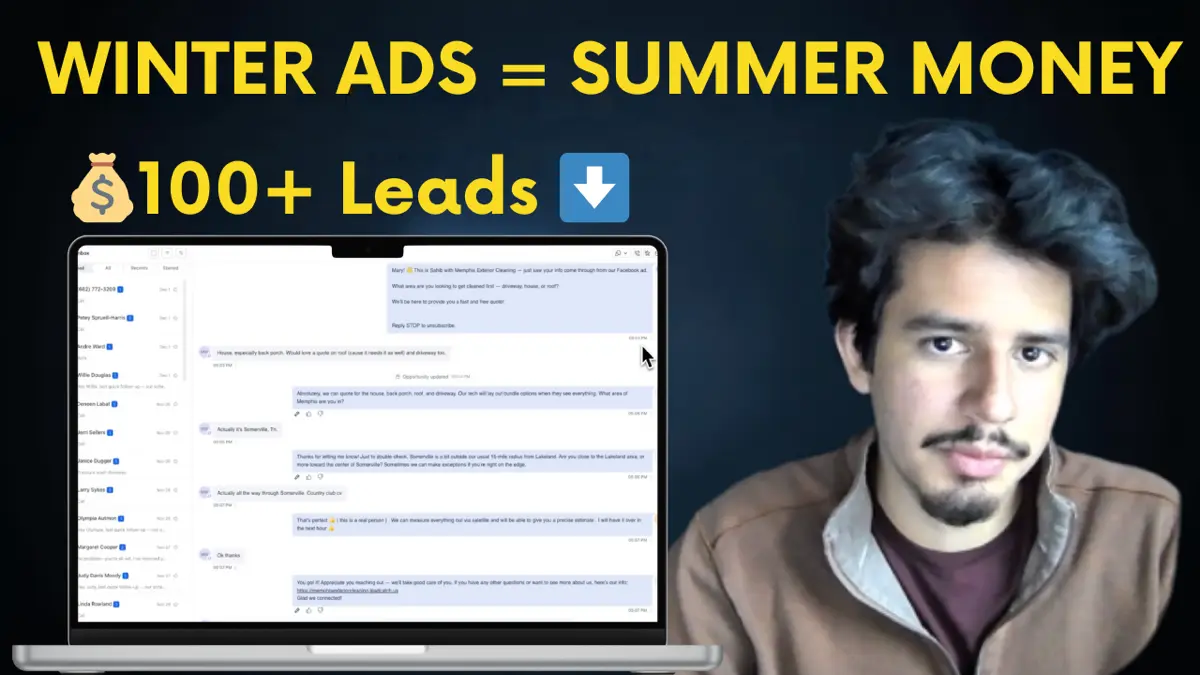
Run Facebook Ads in Winter or Lose $100K Next Season (Pressure Washing)
Winter pressure washing ads are the secret to six-figure spring seasons. See real December 2024 results and learn why running ads now builds momentum your competitors will never catch.
· 10 min read
Facebook Ads
How to Get Instant Notifications for Facebook Ad Leads (Never Miss Another Lead)
Discover how to automate Facebook lead follow-up with instant SMS notifications and AI-powered conversations that never let a lead go cold.
· 8 min read